TECHNE
CONTOUR
Transient Shaper
More punch, or less, band by band.
Bring up the click of the kick, tuck its boom, and leave the hats alone. Up to four bands, each with its own attack and sustain.
Coming in November. Get the launch email:
You’ll join the Techne Signal List: new plugins, drops and releases. Unsubscribe anytime.
- macOS · Windows
- VST3
- CLAP
- 5 machines
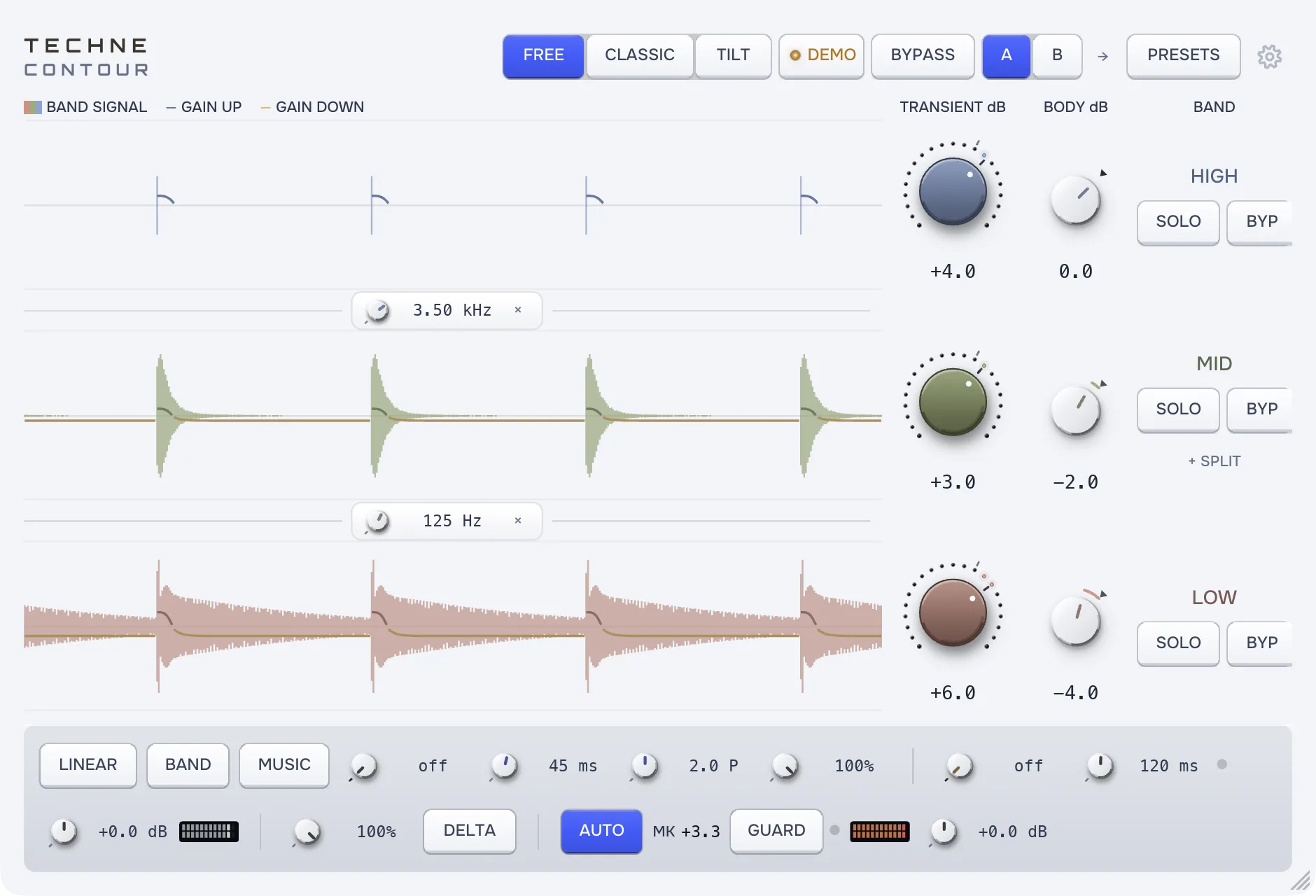
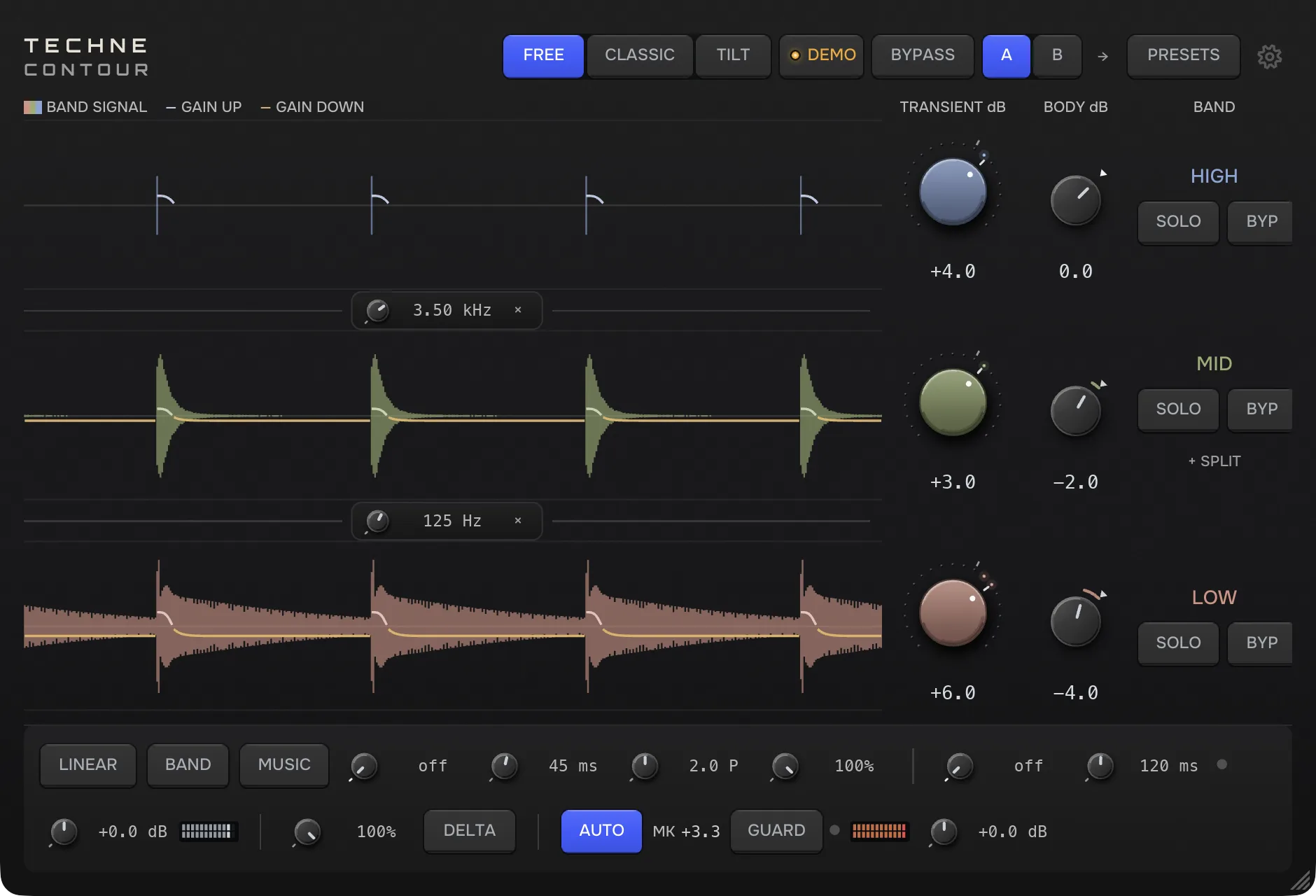
The hit, and what rings after it
The front of every hit. Turn it up for more snap on a kick, a snare or a plucked bass. Turn it down to soften hits that poke out of the mix.
What rings on after the hit. Pull it down to dry up a boomy kick or a roomy snare. Push it up to bring the room back.
Each band gets its own pair of dials. More click on the kick, less boom under it, and the hats left alone. Try it on a drum bus or a full loop.
FREE gives each band two dials. CLASSIC and TILT give it one knob, more attack or less, and TILT can lean it toward weight or toward edge.
See every band
Each band gets a lane: its slice of the sound, with a line over it that rises on the hit and dips after it. You see what every dial is doing, hit by hit.
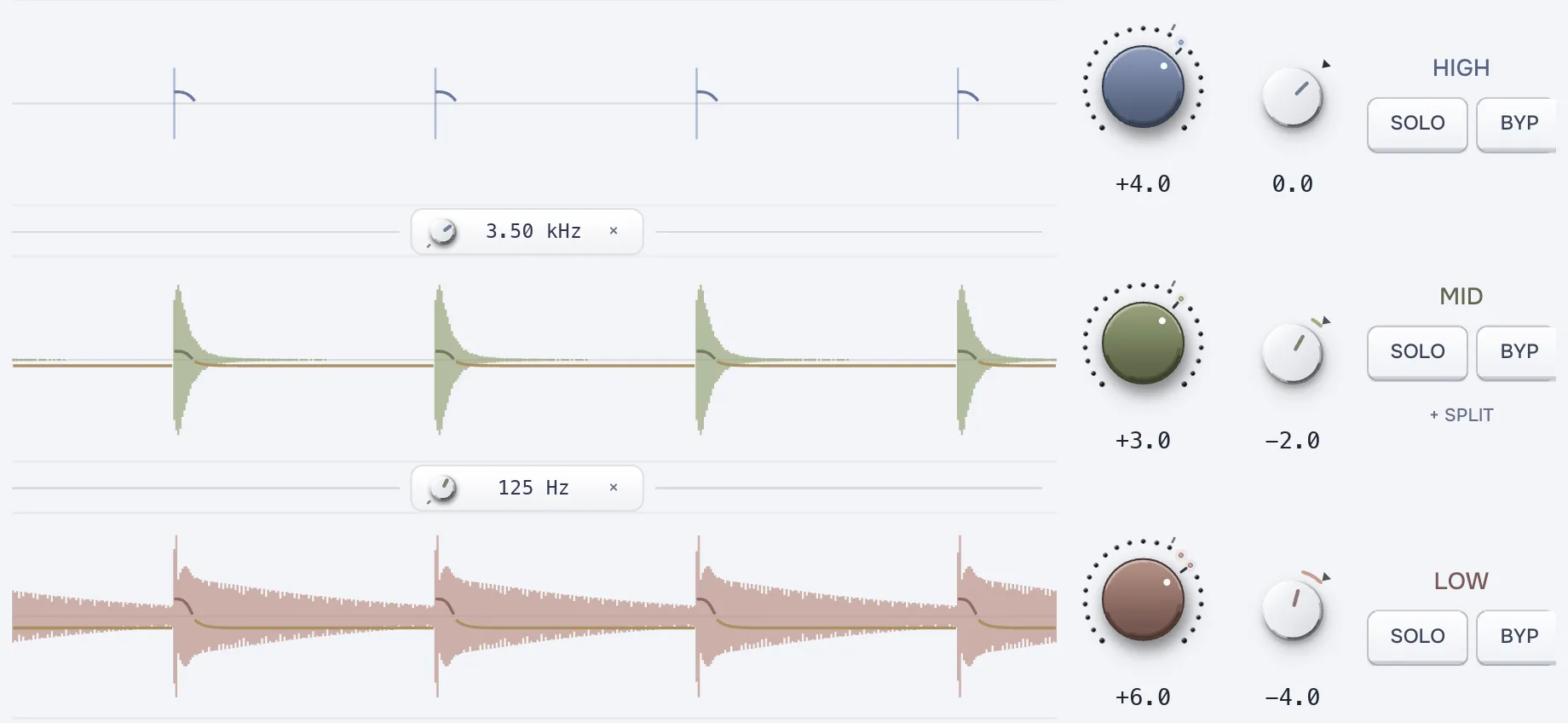
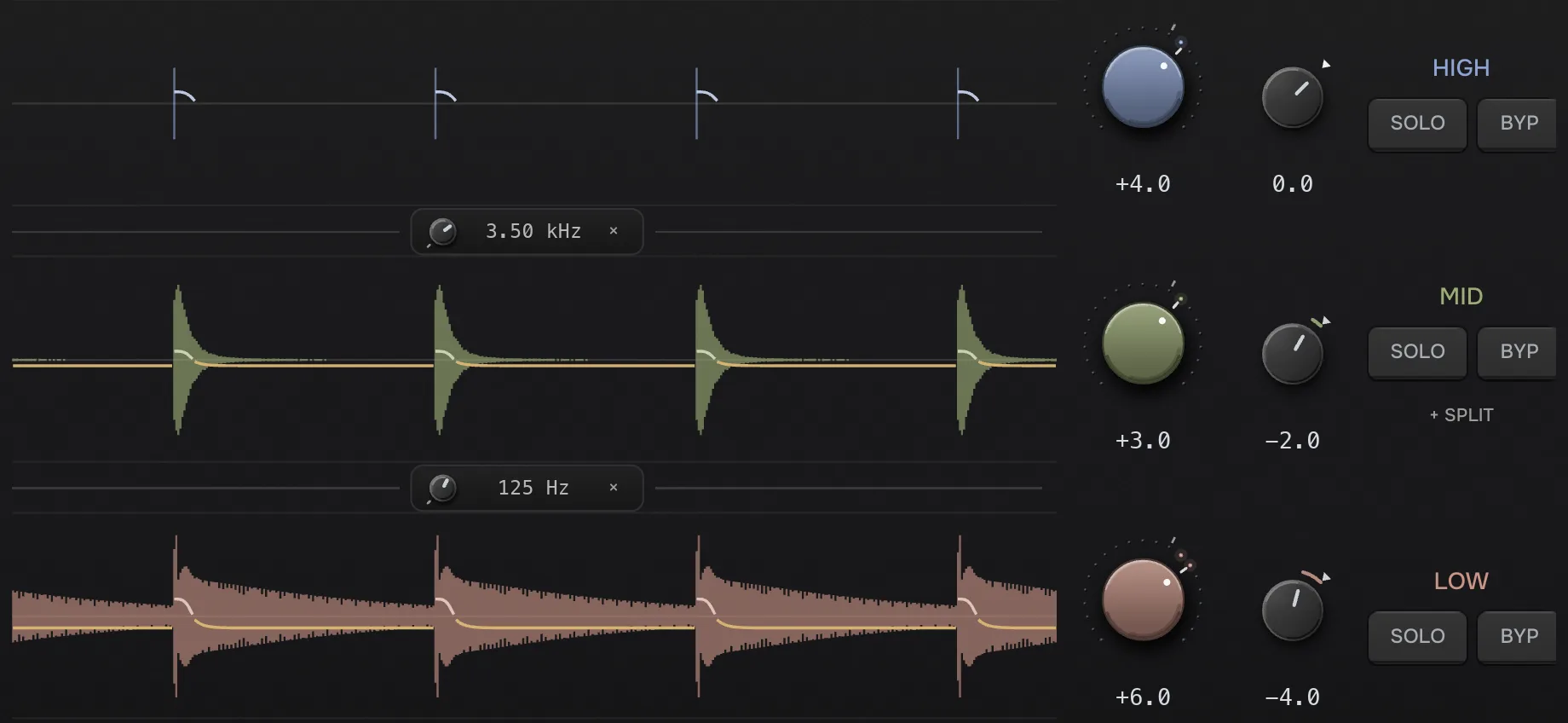
Set the split between two bands where your mix needs it. + SPLIT adds a band, up to four. × takes one out.
SOLO plays one band on its own, so you hear what you’re shaping. BYP leaves a band untouched.
DELTA plays just what Contour adds or takes away: the extra snap, or the ring it pulled out.
AUTO holds the level between hits, so more attack sounds like more attack, not just louder. GUARD softly catches the peaks a big boost makes.
Specs
Technical details The detector, the split, the modes and the level controls.
Per band, in dB: TRANSIENT −36 to +24 on the onsets, BODY −24 to +12 between them. The onset sample itself gets TRANSIENT; the excursion holds about 10 ms, then falls back to BODY.
One wideband detector drives every band by default: a peak follower on the first difference against two cascaded references, one for boosts and one for cuts. A hit’s strength follows the size of its jump, from 2 dB to full at 22, so a small step is a small event and a hit from silence a full one.
BAND detects each band on its own signal, so a hat cannot open the lows. MUSIC, for dense or tonal material, takes each band’s strength from its own jump on the wideband timing and scales the gate by the crest factor, so small jumps still count.
LENGTH scales the onset window, 10 to 200 ms (45, the measured window, by default). HPF is a high-pass in front of the detector, off to 500 Hz; the audio is untouched. LINK, 0 to 100 %, follows the larger channel’s detection, so a panned hit does not move the image.
FREE: TRANSIENT and BODY per band. CLASSIC: one AMOUNT per band, ±45, resolved to onset and body on a fixed law (+45 is +6.7 dB on the onset with the body at −10; −45 is −38.7 with the body at +3). TILT: AMOUNT in dB on the onset, leaned up to ±3 dB per octave about 300 Hz (WEIGHT ↔ EDGE), each band’s body set by a loudness match.
One to four: three crossovers, each on or off, at 40–400 Hz, 200 Hz–2 kHz and 1–8 kHz. Three bands at 125 Hz and 3.5 kHz out of the box. SPLIT starts the new band from the split band’s settings; removing a crossover keeps the lower band’s.
A zero-latency Linkwitz-Riley (LR4) tree with allpass compensation, which delays the lows a few ms behind the highs. LINEAR swaps in a linear-phase FIR pair (1601 taps at 48 kHz, scaled with the rate) run as partitioned FFT convolution: no phase rotation, no smear on a low onset.
RECOVERY, 0 to 4, bounds how fast a band’s excursion falls, in periods of its lower crossover, so a cut on a 40 Hz kick holds across cycles and keeps the wave’s shape. PUMP dips a band after each onset, up to 24 dB, recovering over TIME (20 to 500 ms).
AUTO is body-matched makeup: the level between hits brought back to the input’s over about a second, within ±12 dB, with the peaks left free. GUARD is a soft clip after OUTPUT, its knee from −1.4 dBFS to the ceiling.
MIX is a linear blend against the split’s own unshaped sum, so no setting combs at the crossovers. DELTA is the wet signal minus that sum.
Zero with the default split. LINEAR adds 800 samples at 48 kHz (about 17 ms), reported to the host; BYPASS is delayed to match.
Two stereo aux outputs, Transient and Body, that sum to the main output. INPUT and OUTPUT trims ±24 dB; IN and OUT meters with held peaks.
TRY IT ON YOUR DRUMS
Contour lands in November. Leave your email and we’ll tell you the day it lands.