TECHNE
TAPER
Envelope Shaper
A volume and filter shape that restarts on every hit.
Tighten a snare, chop a pad to the beat, or open a bass’s filter on every kick. It hears each hit, or follows your grid, another track or MIDI.
Coming November. Get the launch email:
You’ll join the Techne Signal List: new plugins, drops and releases. Unsubscribe anytime.
- macOS · Windows
- VST3
- CLAP
- 5 machines
One shape, every hit
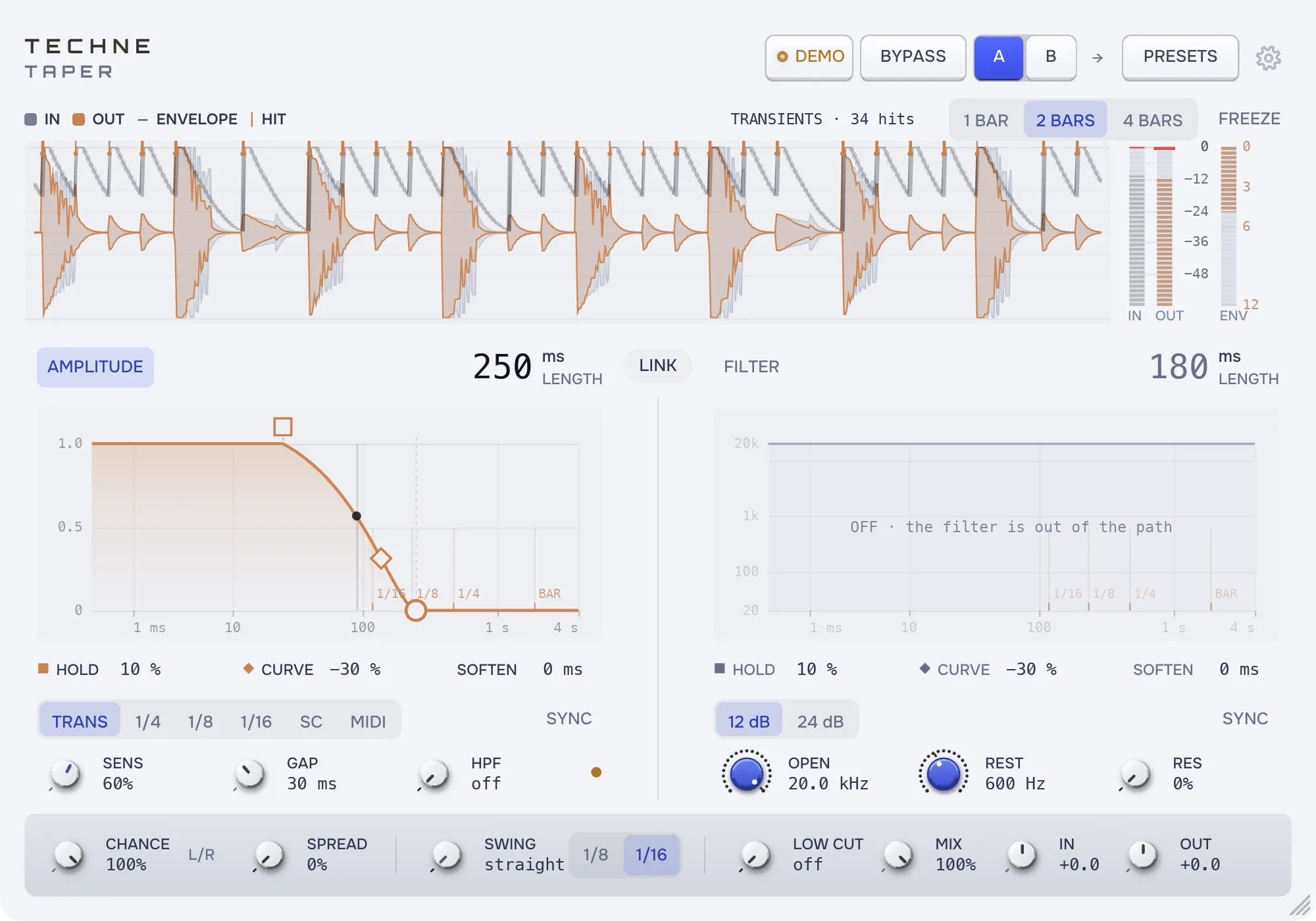
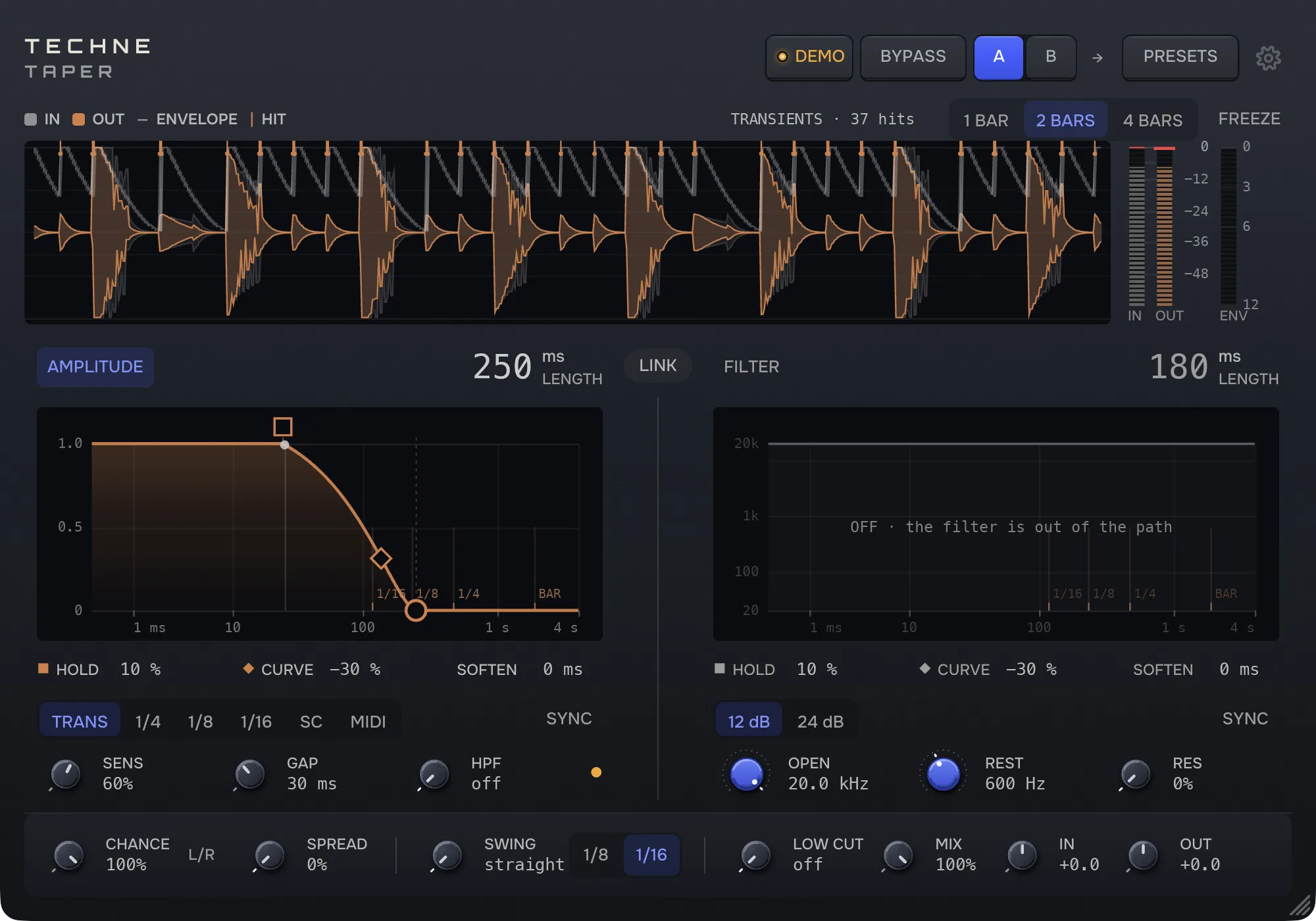
Taper listens to the track and starts the shape on each hit. Keep the crack of a snare and lose the ring, or pull a roomy drum loop in tight. Start from Tight Drums or Gated Room.
Or let it follow your song in quarters, eighths or sixteenths. A held pad or a chord turns into a rhythm, and SWING gives it a shuffle. Start from Sixteenth Chop.
SC lets the kick on another track start it, so a bass brightens on every kick. MIDI starts it from notes you draw in a clip, so the pattern is yours.
See every hit
Taper draws what it’s doing: every hit it caught and the shape it put on it. FREEZE holds the picture still so you can read it.


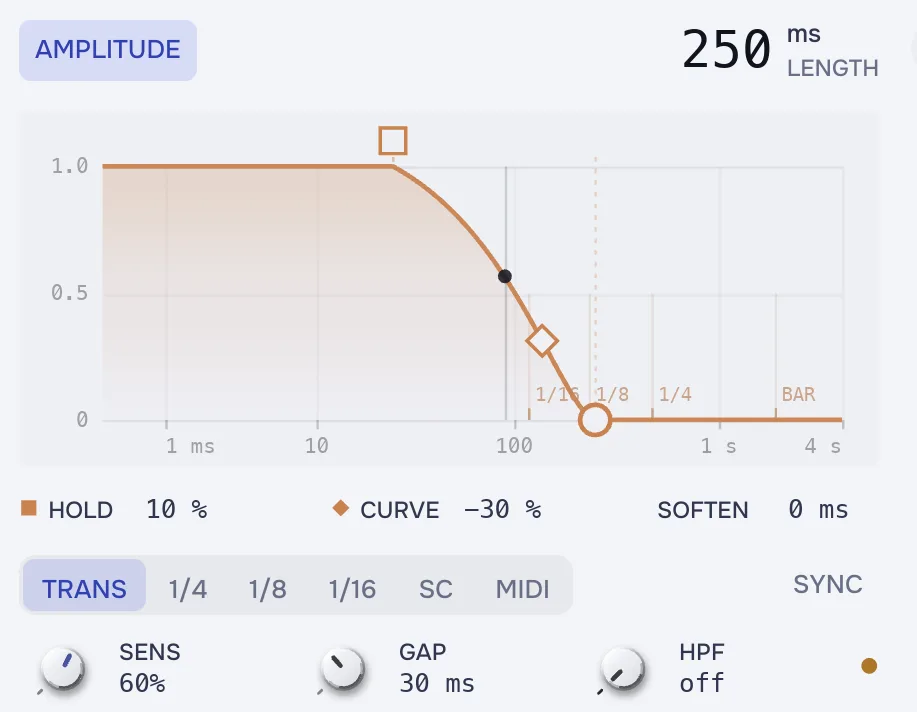
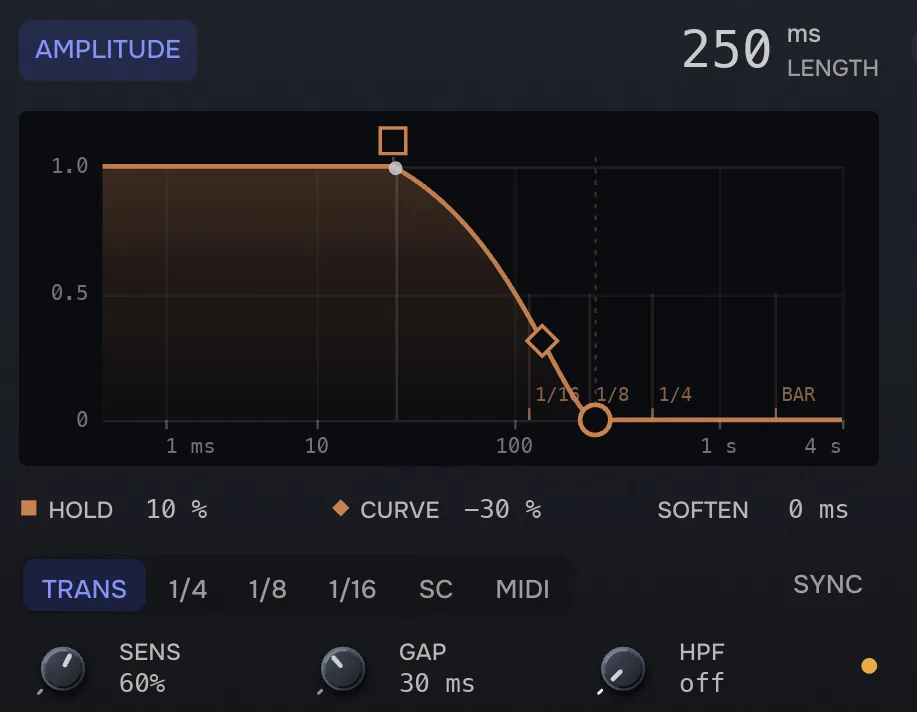
The square sets how long a hit stays at full level. The diamond bends the fall: down for a drum’s natural decay, up for a hard, gated stop.
Drag the circle to set how long the shape lasts, from a click to a long fade. SYNC counts it in notes instead, so it follows the tempo.
The second panel moves a filter the same way: bright on the hit, darker as it falls, or the other way round. LINK gives both shapes the same timing.
CHANCE lets some hits through untouched, so they ring out whole. SPREAD makes each shape a little longer or shorter. Play from the same spot and it comes out the same.
Specs
Technical details The triggers and the detector, the two envelopes, the filter and the latency.
TRANS: onsets detected in the input. 1/4, 1/8, 1/16: the host’s grid from its beat position, once per step, refired after a loop or a seek, nothing while the transport is stopped. SC: onsets in the sidechain bus while the main input is shaped. MIDI: every note-on at its sample; velocity and note-off are ignored.
The first difference of the louder channel into a peak follower (13 ms hold, 5 ms release), judged against the level just before the rise, above a −54 dB floor. SENSITIVITY is the jump that counts: 18 dB at 0 %, 3 dB at 100 %, about 9 dB at the default 60 %. GAP 5 to 500 ms; HPF (off to 500 Hz) filters the detector only.
Unity at the onset, HOLD (0 to 100 % of LENGTH), then a fall to zero of shape (1 − u)^k, k = 2^(2.5 · CURVE), closed until the next event. LENGTH 1 ms to 4 s, or synced from 1/64 to 2 bars with triplets. SOFTEN: a 0 to 50 ms one-pole on every transition. A retrigger ramps from the current gain, never jumps.
A trapezoidal state-variable low-pass, 12 or 24 dB/oct (two in series), swept from OPEN to REST (20 Hz to 20 kHz) in the log domain and capped at 0.45 × the sample rate. RESONANCE up to about +16 dB per stage, bounded so it never rings on its own. The panel’s switch is the bypass, an 8 ms crossfade.
Couples timing only: LENGTH, HOLD, CURVE, SOFTEN and SYNC. Turning it on copies the panel touched last onto the other. The cutoffs, the resonance and the two ON switches stay separate.
CHANCE: the odds an event is shaped; a skipped one leaves the envelope open until the next. SPREAD: LENGTH scaled by up to 2^±1 per event. One draw per event, shared by both channels unless L/R is on, reseeded from the transport position. SWING 50 to 90 % on every second 1/8 or 1/16, grid triggers only; 1/4 never swings.
1.5 ms of lookahead (72 samples at 48 kHz), reported to the host, so the opening ramp ends on the onset sample. The dry path, BYPASS and the strip are delayed with it: MIX is a linear blend of one aligned signal, free of comb filtering.
LOW CUT: a 12 dB/oct Butterworth high-pass on the audio path before the filter, off to 500 Hz; off is a true bypass. INPUT and OUTPUT trims ±24 dB. BYPASS: the delayed input, an 8 ms crossfade.
Peak IN and OUT with held peaks and OUT MAX (red once the true peak passes 0 dBTP); ENV, the envelope’s attenuation, 0 to 12 dB. The strip: the aligned input under the output as min / max columns, the applied envelopes over them, a tick per event (gray when skipped). SPAN 1, 2 or 4 bars; FREEZE.
TRY IT ON YOUR DRUMS
Taper is due in November. Leave your email and we’ll tell you the day it lands.