TECHNE
BUSS COMP
Bus Compressor
Glue for drums and mixes, and a meter that shows how hard it’s pressing.
Pull a drum bus or a whole mix together, keep the kick from pumping everything else, and hear the compression instead of the volume.
Coming November. Get the launch email:
You’ll join the Techne Signal List: new plugins, drops and releases. Unsubscribe anytime.
Or get it free: buy Clipper now Every Clipper bought before Buss Comp launches gets Buss Comp free on release day. No code, nothing to claim. See Clipper →- macOS · Windows
- VST3
- CLAP
- 5 machines
Glue, without the pump
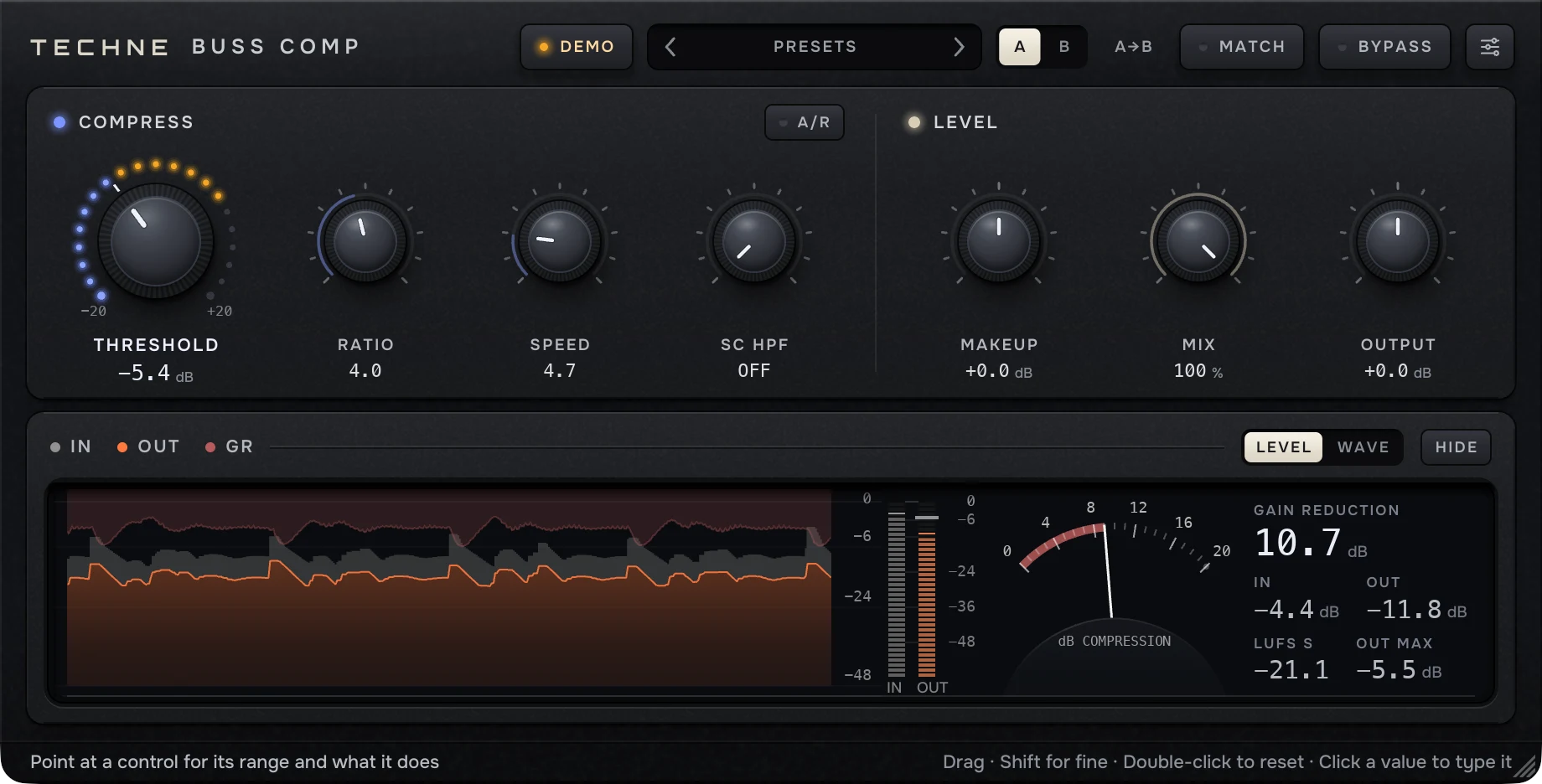
Pulls the parts of a drum bus or a mix together so they move as one. How hard, how much, how fast: three knobs, and it sounds right early.
Keeps the kick from pumping the bus. The low end stops driving the compressor, so the snare and hats don’t duck on every kick. The sound itself isn’t filtered.
Compare at the same loudness. MATCH evens out the level while you flip BYPASS, so you hear what the compression does, not just a volume change.
See what it’s doing
Most bus compressors hide their work behind one needle. Buss Comp draws it: the reduction on every hit, the needle for the moment, and the numbers beside them.

The shaded band hanging from the top is the reduction over the last two seconds. See which hits it catches.
Zero to 20 dB of compression on a dial, eased like the real thing, with the number beside it.
MIX sets how much of the compressed sound sits under the dry one: parallel compression without extra tracks.
One SPEED knob does both. When you want them apart, A/R gives the release its own knob.
Specs
Technical details The gain stages, the detector filter, MATCH and the meters.
Logical4’s gain structure, ported bit-exact: three dynamic gain stages in series. RATIO (1 to 16) walks the output through them; 1 is dry, 4, 9 and 16 bring in each stage. No fixed knee: the followers chase the level’s square.
−20 to +20 dB of drive into the stages, undone at their output; 0 dB is the original’s own level. Its ring meters the input on the knob’s scale.
One rate for attack and release, 1 fastest to 100 slowest: a rate scale, not a time. A/R splits it into ATTACK and RELEASE; set equal, the audio is the original exactly.
A second-order high-pass in front of every stage’s detector, OFF or 1 to 500 Hz. The audio path is untouched; 60 to 120 Hz is the bus region.
A slow gain (a 250 ms one-pole, ±24 dB) that holds the output’s short-term loudness (BS.1770, 3 s) at the input’s. A click on its reading bakes it into OUTPUT.
A linear wet / dry blend against the untouched input, then a ±12 dB OUTPUT trim after MIX that works while bypassed.
Gain reduction (the deeper channel, 10 ms mean) as a history, a needle and a number; peak IN and OUT with held peaks and OUT MAX; short-term LUFS.
A 10 ms crossfade; the compressor keeps running underneath and comes back warm.
TRY IT ON YOUR BUS
Buss Comp lands in November. Leave your email and we’ll tell you the day it lands.